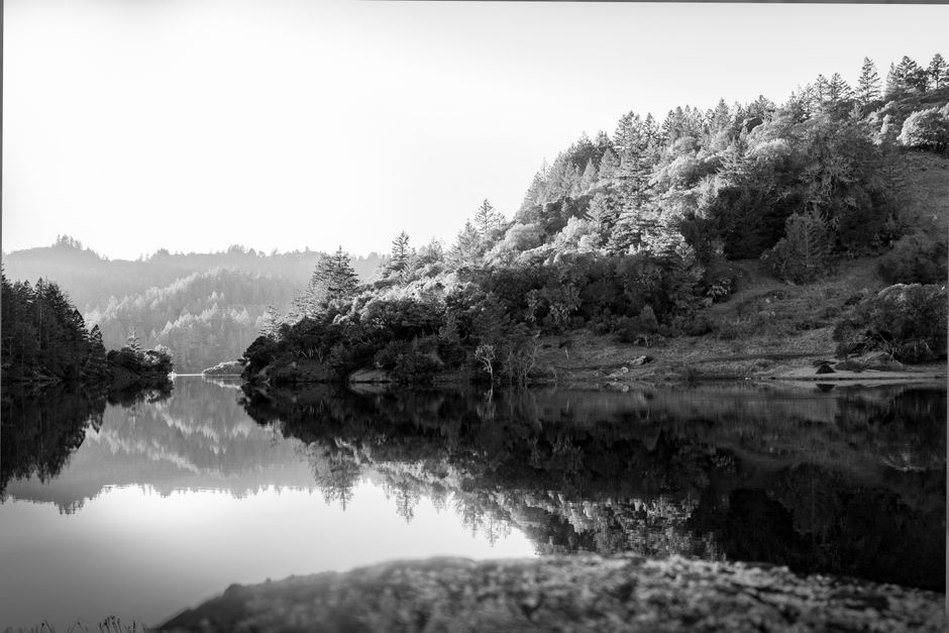
The Ladoga Lake is the largest lake in Europe. Total area of the Ladoga Lake is 18,135 square kilometers, and 457 of them are islands.
There are over 650 islands whose area exceeds 1 hectare, and about 500 of them are located near the north-west shore. The intricate shapes of the rocky islands that rise up to 60–70 meters go with an indented shoreline cut deep by numerous bays. The lake is an inexhaustible source of drinking water for the second largest city of Russia – Saint Petersburg.
Nature worked at the artistic appearance of the Ladoga Lake for many millions of years. Its northern part is located on the Baltic shield, whose formation dates from the ancient ages of the Earth’s evolution. The shield’s rocks are mainly granite, gneiss, and crystalline shale of the so-called Archaean age. These rocks appear on the surface and are only rarely covered with a thin layer of later ages’ rocks.
From the plumb shores of the northern part of the lake one can see the delightful panoramic view of little islands rising over the lake’s silver surface. Figures show the indentation well: the skerries area takes 790 kilometers out of the total shoreline, which is 1,570 kilometers.
32 rivers run to the Ladoga. It is the full-flowing Svir that keeps a huge source of energy; it is small, winding among forests and meadows, rivers of the northern shore; it is the straightforward Volhov; it is the Vuoksa that flows through many lakes. There are rivers whose sources are located 20–40 kilometers from the Ladoga. Others keep flowing for a few hundred kilometers.
All rivers of the Ladoga are of different sizes, but all of them serve as a main feeding source for the lake. The rivers bring about 70 cubic kilometers of water annually. In some years this figure can grow up to 100. Rain and snow that participate in filling up the lake take 15% of the total tributary; the ground waters – only 2%.
The resource of the Ladoga is 908 cubic kilometers. It is not stable: in some periods it grows, in others it drops. However, the fluctuation never exceeds 6% of the total volume of water, at least in the last 100 years.
In ancient times the long period of low water level was often explained by supernatural powers. The inhabitants of the shores had different legends.
There was a belief that the water level of the Ladoga grows for 7 years and then drops for 7 years (the probable reason is that the number 7 is considered to be lucky). Periods of low water level were considered to be bad events. In the 18th and 19th centuries, they had a strong influence on Saint Petersburg’s life, whose economic development was associated with shipping. At those periods, shipping was difficult and suffered damage. Transportation of goods decreased, prices grew, and that caused troubles for the poor first.
Since ancient times, shipping on the lake was very risky. Thousands of ships had crushed in its waves. That became a reason why all insurance companies refused to insure the ships sailing with cargo. It was not only poor equipment of ships and lack of good navigation but also the natural features of the Ladoga. The famous explorer A.P. Andreev wrote: “The Lake is stormy and filled with stones.”
The reason for the Ladoga’s severe temper is the special structure of its basin, distribution of depths, and shapes of the lake. A keen fracture of the floor that changes from deep waters of the northern part to shallow waters of the southern part prevents the formation of “regular” waves across the whole length of the lake.
Such a wave can appear only in the northern part. Being blown by the winds to the south, it keeps its shape only under deep waters. As soon as it comes to an area of 15–20 meters depth, it breaks. It becomes high but brief. Its crest drops. A compound system of waves arises and runs in different directions; that is the so-called “crowd.” It is especially dangerous for small ships that suffer from a sudden and powerful jolt.
There was another feature of waving at the lake noticed. The waves alternate at the time of the storm – a group of 4 or 5 high and long waves changes to a group of lower and shorter ones. A ship takes this phenomenon as a bumpy road. It causes a rolling that negatively affects the hull. Exploration of the waving on the lake is quite difficult. The highest wave that was measured reached 5.8 meters. It is supposed to be higher at the time of the storm.
There are 58 fish species, including five species settled by man at the Ladoga. Probably the most valuable fish of the Ladoga are salmon of seven species. Except for entering sea salmon, the Ladoga is full of lake salmon and lake trout.
Travelers who hike the Ladoga often see seals that look out from the water not far from a motor ship. The seal is the only mammal that constantly lives in the Ladoga waters. More than ten hundred years ago its ancestry came from the White Sea hollow to the Karelian glacial sea that became the Ladoga lake later.
Animals acclimatized in the new reservoir and now they are quite common in the Ladoga. Seals like to sun themselves on the shore rocks. They funny scratch themselves. One can see them often floating on a log.
The last but not least animal that should be mentioned is a dolphin that occasionally comes from the Baltic Sea to the Neva and the Ladoga Lake.
Translated by Ekaterina Zharova